
First-Time Homebuyer’s Guide to Winnipeg: Programs, Costs, and Neighbourhoods for 2026-2027
 By Cyndy Erickson, Broker, Lifestyles Real Estate Ltd. · Updated
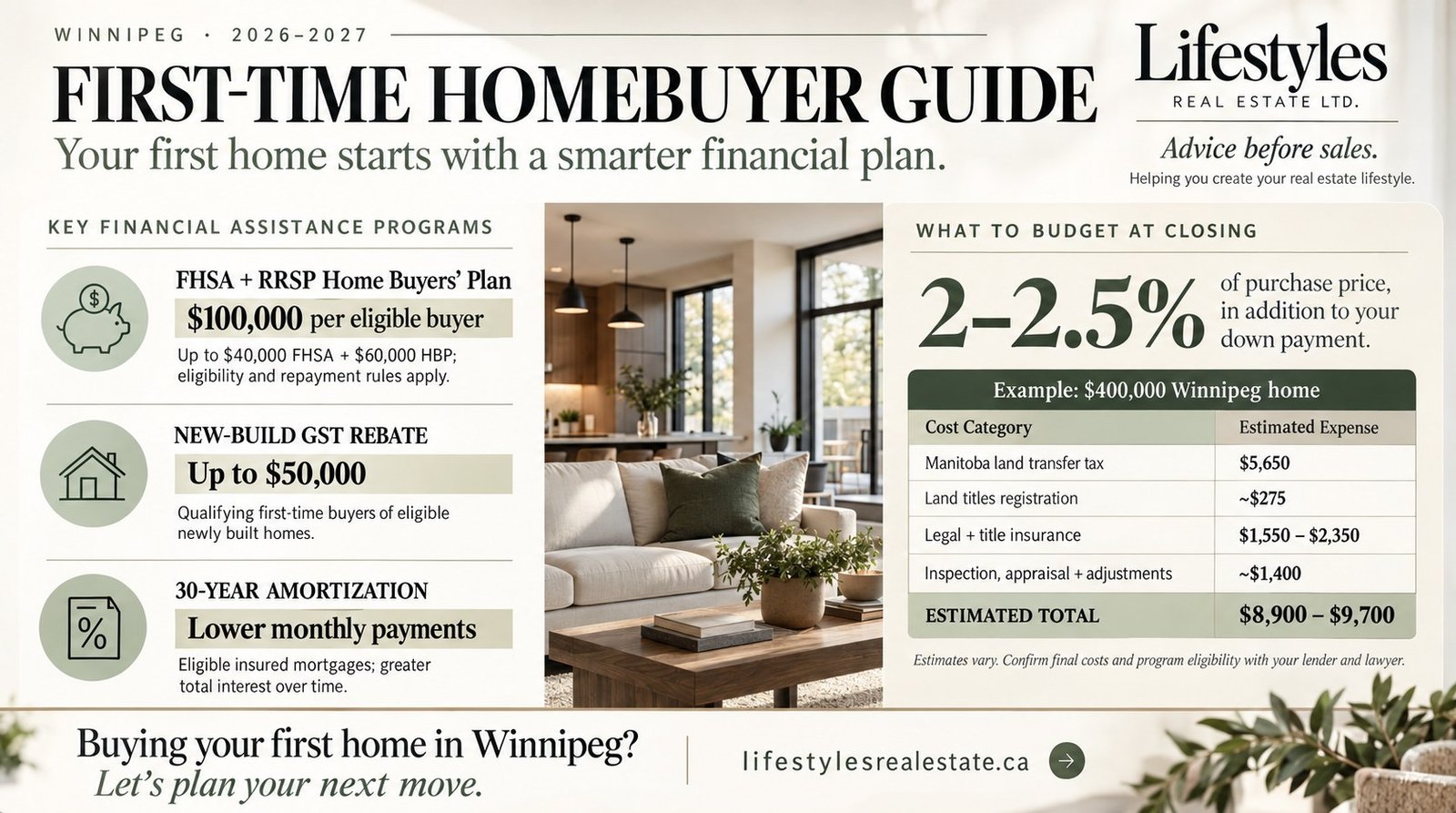
The short answer: Yes, you can still buy a house in Winnipeg on your first try. Detached homes start in the high $200,000s in some neighbourhoods. Ottawa does most of the heavy lifting: an FHSA (up to $40,000) and the RRSP Home Buyers’ Plan (up to $60,000) work together, giving you up to $100,000 per buyer, or $200,000 for a couple. Manitoba has no first-time buyer rebate on land transfer tax, so set aside about 2–2.5% of the price in cash for closing day.
Winnipeg is different. In Toronto, a first home takes two incomes and a parent’s help. Here, plenty of people still buy a detached house on one paycheque, in a real neighbourhood, with a yard.
But affordable doesn’t mean easy. Manitoba gives first-time buyers less than most provinces do. There’s no land transfer tax rebate. The main provincial program doesn’t cover Winnipeg. And the programs that do help you (federal accounts, tax credits, income-tested grants) only pay off if you start planning months before you look at a single listing.
That’s what this guide is for. It covers every program, every closing cost, and every price tier, updated for fall 2026.
What you’ll find here
- The 2026 Winnipeg market at a glance
- Every federal and provincial program available to first-time buyers
- Neighbourhood-by-neighbourhood price tiers
- A realistic breakdown of closing costs
- The buying process, step by step
The Winnipeg Market in 2026: What First-Time Buyers Need to Know
The market is balanced. Mostly. At the entry level, it still leans toward sellers. Homes between $350,000 and $450,000 are where first-time buyers shop, and there aren’t enough of them, so a well-priced house in a good neighbourhood can still draw several offers in spring and fall.
Step back and look at the country, and Winnipeg’s advantage is obvious. Toronto and Vancouver benchmark prices sit above $1 million. In Winnipeg, detached-home prices vary widely by area; the Winnipeg Regional Real Estate Board reported an average residential-detached price of $467,687 through September 2026, with the year-to-date average inside Winnipeg proper at $479,807. Condos averaged $288,751 across the board region. That gap is why buyers who’ve been priced out of other cities keep moving here.
Price tiers at a glance
| Category | Typical price range | What you get |
|---|---|---|
| Entry-level condos | $200,000–$280,000 | 1–2 bedroom units, older buildings, some downtown |
| Entry-level detached | $280,000–$400,000 | Bungalows and older homes in value neighbourhoods |
| Mid-market detached | $400,000–$500,000 | 3-bedroom homes in established neighbourhoods |
| New south-end builds | $500,000–$600,000 | Bridgwater, Sage Creek, Waverley West |
| Prestige | $600,000+ | Tuxedo, Crescentwood, Linden Woods |
Ranges are approximate asking prices as of fall 2026, and they change street by street. Ask us for current sold prices in the neighbourhoods you’re considering.
What this means for you
Most first-time buyers compete in the entry-level and mid-market tiers. Under $400,000, good homes in established neighbourhoods sell fast. Over $500,000, you usually have room to negotiate. With a budget under $300,000, your best options are condos, townhouses and older bungalows. Between $300,000 and $400,000, detached homes in Transcona, St. James, St. Vital and East Kildonan are within reach. Browse our current Winnipeg listings to see what your budget buys today.
One more thing works in your favour: 30-year amortization. Since December 15, 2024, every first-time buyer, and anyone buying a newly built home, can spread an insured mortgage over 30 years instead of 25. On a $400,000 mortgage at about 4.5%, that cuts the payment by roughly $190 to $200 a month. It also raises how much you qualify for. The trade-off is small: CMHC adds 0.20% to your insurance premium.
First-Time Buyer Programs: What’s Available in 2026
Here’s the truth. The federal programs are strong. The provincial ones are thin. Below is what applies to most Winnipeg buyers, and what doesn’t.
Federal programs (available to most Winnipeg buyers)
First Home Savings Account (FHSA). Start here. You can put in $8,000 a year, up to $40,000 in total. Your contributions are tax-deductible, like an RRSP. And when you take the money out to buy your first home, you pay no tax at all, like a TFSA. Your room starts the year you open the account, and up to $8,000 of unused room carries forward, so open one today, even if you won’t buy for years.
Home Buyers’ Plan (HBP). You can take up to $60,000 out of your RRSP, tax-free, to buy your first home. Two qualifying buyers can take $120,000. The money has to sit in the RRSP for at least 90 days first. You pay it back over 15 years, starting the second year after you withdraw it. The best part? You can use the FHSA and the HBP on the same purchase. That’s up to $100,000 per buyer, or $200,000 for a couple.
Home Buyers’ Amount (tax credit). It’s small, but it’s yours. Claim $10,000 on line 31270 of your tax return for the year you buy, and at the 2026 federal rate of 14%, your federal tax drops by up to $1,400. The credit is non-refundable, so you get the full amount only if you owe at least that much tax. You qualify if neither you nor your spouse or partner lived in a home you owned that year or in the four years before.
First-Time Home Buyers’ GST Rebate (new builds). This one is big. The rebate is now law (Bill C-4 received Royal Assent on March 12, 2026), and the CRA has been accepting applications since March 17, 2026. If you signed your purchase agreement on or after March 20, 2025, and you’re buying a newly built or substantially renovated home, you can get all of the GST back on a home up to $1 million. Between $1 million and $1.5 million, the rebate shrinks. On a new build, that’s up to $50,000 back in your pocket. Most resale homes don’t charge GST anyway, so this mainly helps buyers looking at new construction in Bridgwater, Sage Creek or Waverley West.
30-year insured amortization. No application needed. Your lender sets it up (see above).
Provincial programs: the honest picture
Important: You may have heard of Manitoba Housing’s Affordable Homes Program. It offers forgivable down payment help, but only on homes Manitoba Housing sells itself, in select communities. It does not cover Winnipeg’s resale market. Check the current rules with Manitoba Housing before you count on it.
For most Winnipeg first-time buyers, the help comes from Ottawa. Two Manitoba-specific points still matter:
- Métis citizens: Louis Riel Capital Corporation runs the First Time Home Purchase Program for eligible Red River Métis citizens buying their first home. It pays 5% of the purchase price, up to $18,000, toward your down payment. It adds 1.5%, up to $2,500, toward closing costs. Income and asset limits apply, so confirm you qualify with LRCC before you start shopping.
- Land transfer tax: There’s no first-time buyer break. Everyone pays the same rates. Budget the full amount.
Program summary
| Program | Maximum benefit | Who qualifies |
|---|---|---|
| FHSA | $40,000 tax-free savings | Canadian residents 18+ who are first-time buyers |
| Home Buyers’ Plan (RRSP) | $60,000 per buyer | First-time buyers with RRSP savings |
| FHSA + HBP combined | $100,000 per buyer / $200,000 per couple | Buyers eligible for both |
| Home Buyers’ Amount | Up to $1,400 off federal tax (non-refundable) | First-time buyers |
| GST rebate (new builds) | Up to $50,000 | First-time buyers of new or substantially renovated homes (agreements from March 20, 2025) |
| 30-year amortization | About $190–$200/month lower payment on $400,000 | First-time buyers and new-build buyers with insured mortgages |
| FTHPP (Métis citizens) | Up to $18,000 down + $2,500 closing | Eligible Red River Métis citizens |
Winnipeg Neighbourhoods for First-Time Buyers: Where to Look by Budget
This is where Winnipeg’s affordability stops being a statistic and starts being a street. Know which tier your pre-approval puts you in. It will save you weeks of looking in the wrong places. The tiers below match the quick-reference table at the end of this section. For a closer look at the areas we know best, see our Winnipeg neighbourhood guide.
Under $300,000: the most house for your money
- North End / East Elmwood: The lowest prices in the city. Three-bedroom bungalows sell for about $180,000 to $250,000. These are value neighbourhoods with real revitalization underway, and they suit buyers who care more about price than walkability and don’t mind an older house.
- Downtown condos: One-bedroom units run about $200,000 to $260,000. Good for singles or couples who want to walk to work.
$300,000–$400,000: the first-time buyer sweet spot
Most first-time buyers land here. So does most of the competition.
- Transcona: One of the most affordable places in the city to buy a detached home. It feels like a small town inside a big one. Starter bungalows and infill homes run from the high $200,000s to about $350,000.
- St. James: Close to the airport. Solid older homes. Prices that stay below the city average year after year.
- St. Vital: Parks, shopping and transit, without the west-side price tag. Many detached homes sell between $370,000 and $400,000, and larger ones go into the $400,000s.
- East Kildonan: River paths, quiet established streets, and a mix of bungalows and two-storeys. A steady place to build equity.
$400,000–$500,000: more space, more character
- Garden City / West Kildonan / Rivergrove: The northwest’s best-kept secret. You get more house and more yard, usually for less than you’d pay in the south end.
- Wolseley: Big trees, character homes, and cafés you can walk to. The houses are old and full of charm, so plan for repairs and updates.
$500,000+: established prestige or brand new
- River Heights: Mid-century homes on tree-lined streets, with resale values that hold up. Next door, Crescentwood and Tuxedo usually start above $600,000.
- Bridgwater / Sage Creek / Waverley West: New south-end communities with modern builds, newer schools and room for families. They cost more. But if you qualify, the new-build GST rebate (up to $50,000) takes a real bite out of that price.
Neighbourhood quick reference
| Budget | Best bets | Home type |
|---|---|---|
| Under $300K | North End, East Elmwood, downtown condos | Bungalows, condos |
| $300K–$400K | Transcona, St. James, St. Vital, East Kildonan | Detached, semi-detached |
| $400K–$500K | Garden City, West Kildonan, Rivergrove, Wolseley | Detached, character homes |
| $500K+ | River Heights, Bridgwater, Sage Creek, Waverley West | Established or new builds |
What Buying Actually Costs: Closing Costs in Winnipeg
Everyone talks about the down payment. Nobody talks about closing costs. Then closing day arrives, and first-time buyers find out the hard way. These costs don’t go on your mortgage. Your lender will want to see the cash, usually at least 1.5% of the price, sitting in your account on top of your down payment.
Manitoba land transfer tax
Manitoba taxes the purchase in five steps. The first $30,000 is free. After that, the rate climbs until it hits 2.0% on everything above $200,000. There’s no first-time buyer rebate.
| Price bracket | Rate |
|---|---|
| First $30,000 | 0% |
| $30,001–$90,000 | 0.5% |
| $90,001–$150,000 | 1.0% |
| $150,001–$200,000 | 1.5% |
| Above $200,000 | 2.0% |
Buy at $400,000, and the land transfer tax is $5,650. Buy at $420,000, and it’s $6,050. On top of that, Land Titles charges to register your transfer and your mortgage. Budget about $275 for both, and ask your lawyer for the current amount. Almost every Winnipeg buyer reaches the 2.0% bracket. Plan for it.
Full closing cost estimate: $400,000 purchase
| Cost item | Estimated amount |
|---|---|
| Land transfer tax | $5,650 |
| Land Titles registration (transfer + mortgage) | ~$275 |
| Legal fees | $1,200–$2,000 |
| Title insurance | ~$350 |
| Home inspection | ~$500 |
| Appraisal (if required) | ~$400 |
| Adjustments and disbursements | ~$500 |
| Total estimated closing costs | ~$8,900–$9,700 |
The rule of thumb is simple. Set aside 2–2.5% of the purchase price for closing costs. That’s on top of your down payment. On a $400,000 home, it’s roughly $8,000 to $10,000, in cash, on closing day.
Down payment requirements
- 5% on the first $500,000 of the purchase price
- 10% on the portion between $500,000 and $1,499,999 (insured mortgages are capped at $1.5 million)
- 20% if you want to skip CMHC mortgage insurance entirely
With less than 20% down, you pay CMHC insurance. The premium runs from 2.8% to 4.0% of your mortgage, depending on your down payment, plus 0.20% if you choose 30 years. You don’t pay it at closing. It’s added to your mortgage. Buy at $400,000 with 5% down on a 25-year amortization, and the premium is about $15,200.
The Buying Process: Step by Step
Step 1: Get your finances in order
Open an FHSA. Do it first, even if you plan to buy this year. Money you put in before you buy is deductible, and you can take it out tax-free for the purchase. Then look at your RRSP. Would the Home Buyers’ Plan help? Remember, the money needs to sit there for 90 days.
Next, get pre-approved by a lender or mortgage broker. A pre-approval tells you what you can really spend. It usually holds your rate for 90 to 120 days. And it tells sellers you’re serious, which matters, because in the entry-level market, buyers without one lose.
Step 2: Decide what matters
In Winnipeg, $40,000 can be the difference between two neighbourhoods. Or between a house with a garage and a house without one. Know what you won’t give up before you see your first home:
- Do you need a garage? After one Winnipeg winter, most people say yes.
- What matters more, a shorter commute or the neighbourhood you love?
- Are you happy to update an older home, or do you want something newer?
- Which school catchment do you need?
Step 3: Work with a local realtor
In Winnipeg, the seller usually pays the buyer’s agent, so working with one typically costs you nothing directly. And local knowledge pays here. Two streets in the same neighbourhood can have different flood risk, different school catchments, and very different long-term value. Meet the Lifestyles team and find an agent who knows the areas you’re looking at.
Step 4: Make an offer
In Manitoba, offers are written on a standard offer to purchase. Your agent will help you set the price, the conditions and the possession date. Most offers include some of these conditions:
- Financing: time to confirm your mortgage approval (usually 5–7 business days)
- Home inspection: a professional inspection before you’re committed (usually 5–7 days)
- Condo documents: for a condo, time to review the status certificate, the condo corporation’s finances and its reserve fund
When several buyers want the same home, people sometimes drop conditions to win. Be careful. Never drop the home inspection unless you know exactly what you’re accepting.
Step 5: Close the deal
Your lawyer takes it from here. They transfer the title, pay the land transfer tax, and move the money. A few days before closing, they’ll send a statement of adjustments with the exact amount you need to bring. From accepted offer to keys in hand usually takes 30 to 90 days. In Winnipeg, 45 to 60 days is most common.
Step 6: Claim your benefits
- Claim the Home Buyers’ Amount on your tax return for the year you buy
- Check that your FHSA withdrawal went through as a qualifying withdrawal
- If you used the HBP, note the year your RRSP repayments start
- If the house needs insulation, windows or a new furnace, check Efficiency Manitoba for current rebates and financing
Common Mistakes First-Time Buyers Make in Winnipeg
Forgetting about closing costs. On a $400,000 home, you need $8,900 to $9,700 in cash. It can’t go on the mortgage. Have it ready.
Opening an FHSA too late. Your room starts the year you open the account. Open it the month you start house hunting, and you’ve thrown away years of tax-free savings.
Skipping the home inspection. Winnipeg has a lot of older houses. Old foundations. Old plumbing. Old furnaces. Waiving the inspection to win a bidding war is a gamble, and the stakes are your savings.
Picking a neighbourhood on price alone. Two homes can have the same price tag and very different futures. Flood risk, school catchments and where the city is investing all shape what your home is worth in ten years.
Borrowing the maximum. Your pre-approval tells you the most a lender will give you. It doesn’t tell you the most you should spend. Leave room for property tax, insurance, repairs and the surprises that come with every first year.
Ready to Buy? Start Here
Winnipeg rewards buyers who prepare. The prices are real. The programs are worth real money when you stack them. And somewhere in this city, there’s a neighbourhood that fits your budget and the life you want to build in it.
The buyers who do this well have a few things in common. They get pre-approved before they view. They know their closing costs before they make an offer. And they work with someone who knows the city block by block, not just postal code by postal code.
That’s what we do. Our team works from 730 St. Anne’s Road in south Winnipeg, and we help buyers in every corner of the city. If you’re not sure where to start, what you can afford, or which programs fit you, let’s talk it through. Advice before sales. No pressure, no obligation. When you’re ready to look, start with our featured listings.
Book a free first-time buyer consultation with Cyndy or call (204) 791-7151.
Sources
- First Home Savings Account (Canada Revenue Agency)
- Home Buyers’ Plan (Canada Revenue Agency)
- Line 31270 Home Buyers’ Amount (Canada Revenue Agency)
- GST relief for first-time home buyers (Department of Finance Canada)
- Mortgage loan insurance (CMHC)
- Land transfer tax (Manitoba Finance)
- First Time Home Purchase Program (Manitoba Métis Federation / Louis Riel Capital Corporation)
- September 2026 Market Release (Winnipeg Regional Real Estate Board)
This guide is general information, not financial, tax or legal advice. Program rules change, so confirm details with your lender, lawyer or accountant before you act.
Thinking about buying or selling in Winnipeg?
Talk to a Lifestyles REALTOR® — call (204) 421-7653.